Murmur: Designing for Emotional Reflection
Category:
Mobile Design
Client:
Indiana University
Designed a mobile application to help users navigate unpleasant memories through guided reflection
My Role
Researcher and Designer
Duration
4 Months From Jan'25 to Apr'25
Methods
Research: Surveys, Interviews, Competitor Analysis
Design: Rapid Prototyping, High-Fidelity Prototyping, Usability Testing
01
OVERVIEW
The Challenge
Everyday unpleasant memories are hard to express and even harder to process.
People tend to remember negative experiences more vividly than positive ones. These memories shape our self-image, emotional well-being, and how we approach the future.
Negative Bias

Figure: “It’s more important for people, for survival, to notice the lion in the bush than it is to notice the beautiful flower that’s growing on the other side of the way,” - Laura Carstensen
How might we support deeper reflection on unpleasant memories without letting users spiral?
Deliberately chose not to approach the topic from a clinical or therapeutic perspective, to keep the focus on everyday reflection and emotional processing rather than diagnosis or treatment.
However, the data generated through this tool could potentially support therapists as a supplemental view into a client’s emotional patterns and self-reflections, if the user chooses to share it.
02
RESEARCH
Research Goals
How do people capture, express, share, and reflect on their unpleasant memories?
What are the individuals’ needs and strategies to process unpleasant memories?
How do individual differences in reflection and rumination tendency change individuals’ unpleasant memory
processes?
Methodology
Literature Review
Reviewed literature on emotional reflection, rumination, and memory technologies. Examined how journaling apps, social media, and AI-based tools shape emotional processing.
Surveys
Piloted small-scale survey to refine questions. Qualtrics survey covering demographics, memory processing habits, cognitive styles, and technology interaction.
03
FINDINGS
Key Findings
1
Reflectors V/S Ruminators
Different people have different attitudes towards technology, and their needs differ significantly based on cognitive style.
2
Role of Social Context
Individual and social acceptance plays a role in the processing of unpleasant memories.
3
Technology Engagement Patterns
Reflectors don't trust technology's effect and have separate processing phases. Ruminators prefer expressive outlets and need to communicate with others.
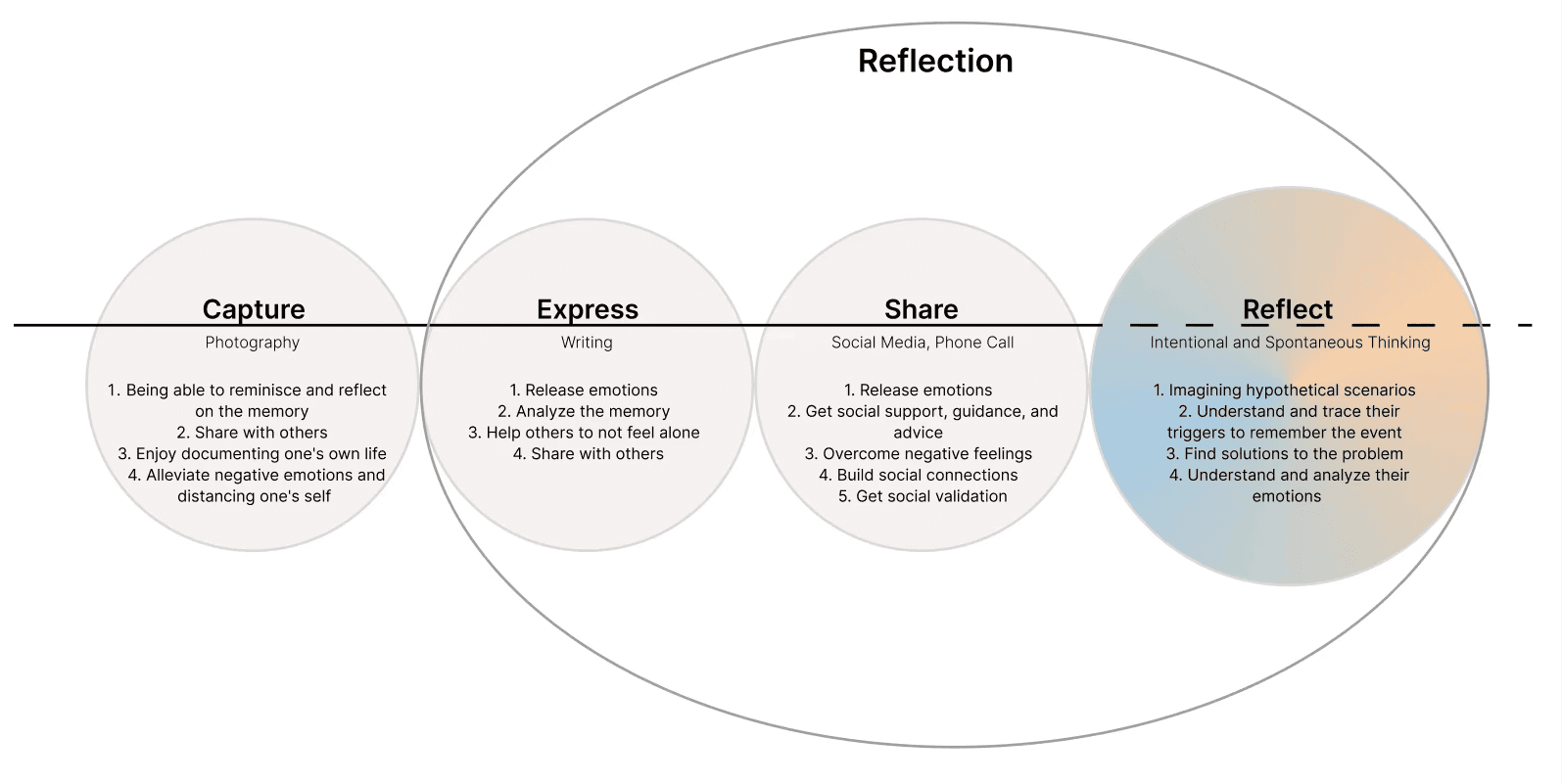
Figure: Memory Processing Model and Motivations of Individuals In Each Stage
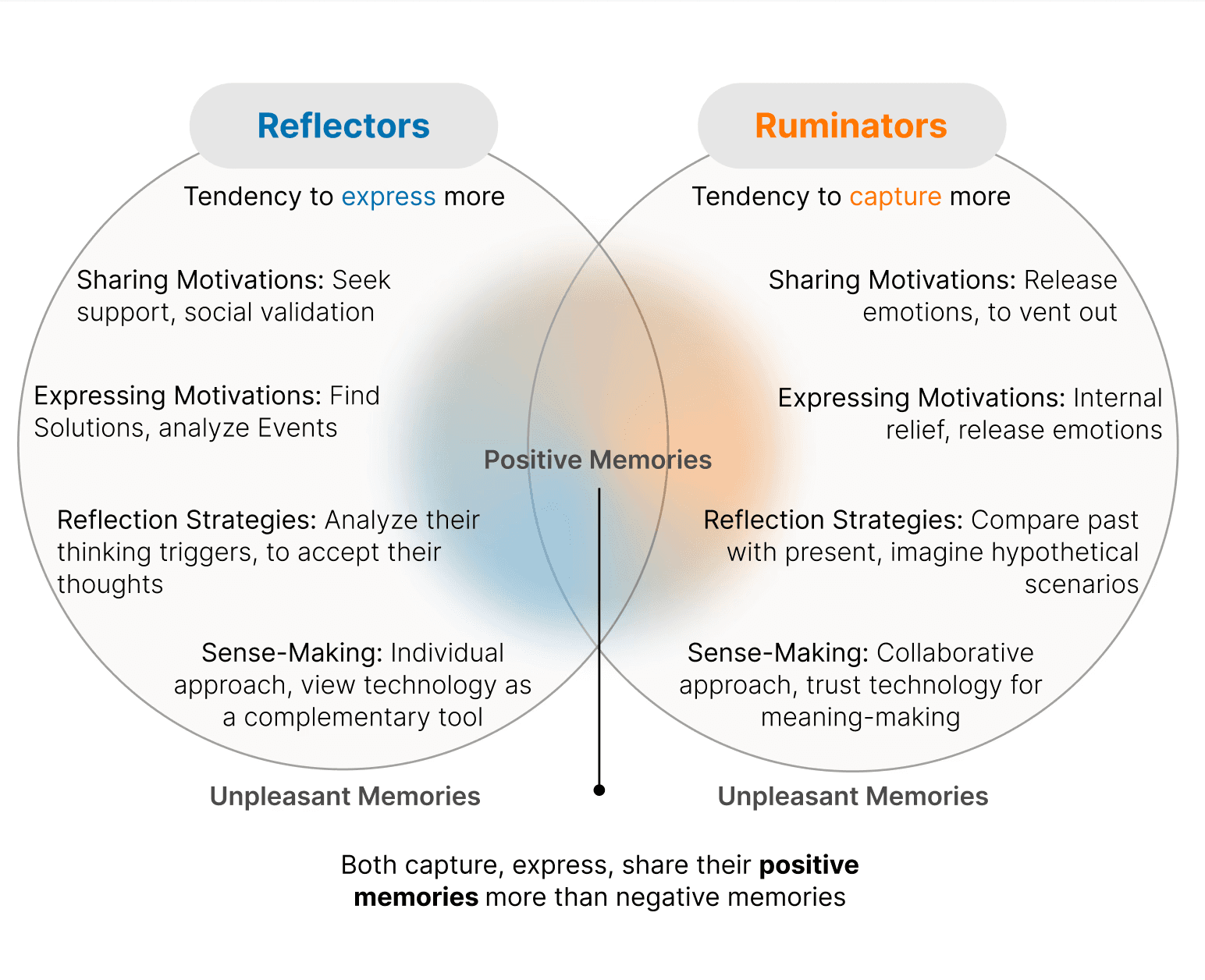
Figure: Comparison of Reflectors vs. Ruminators
04
SOLUTION
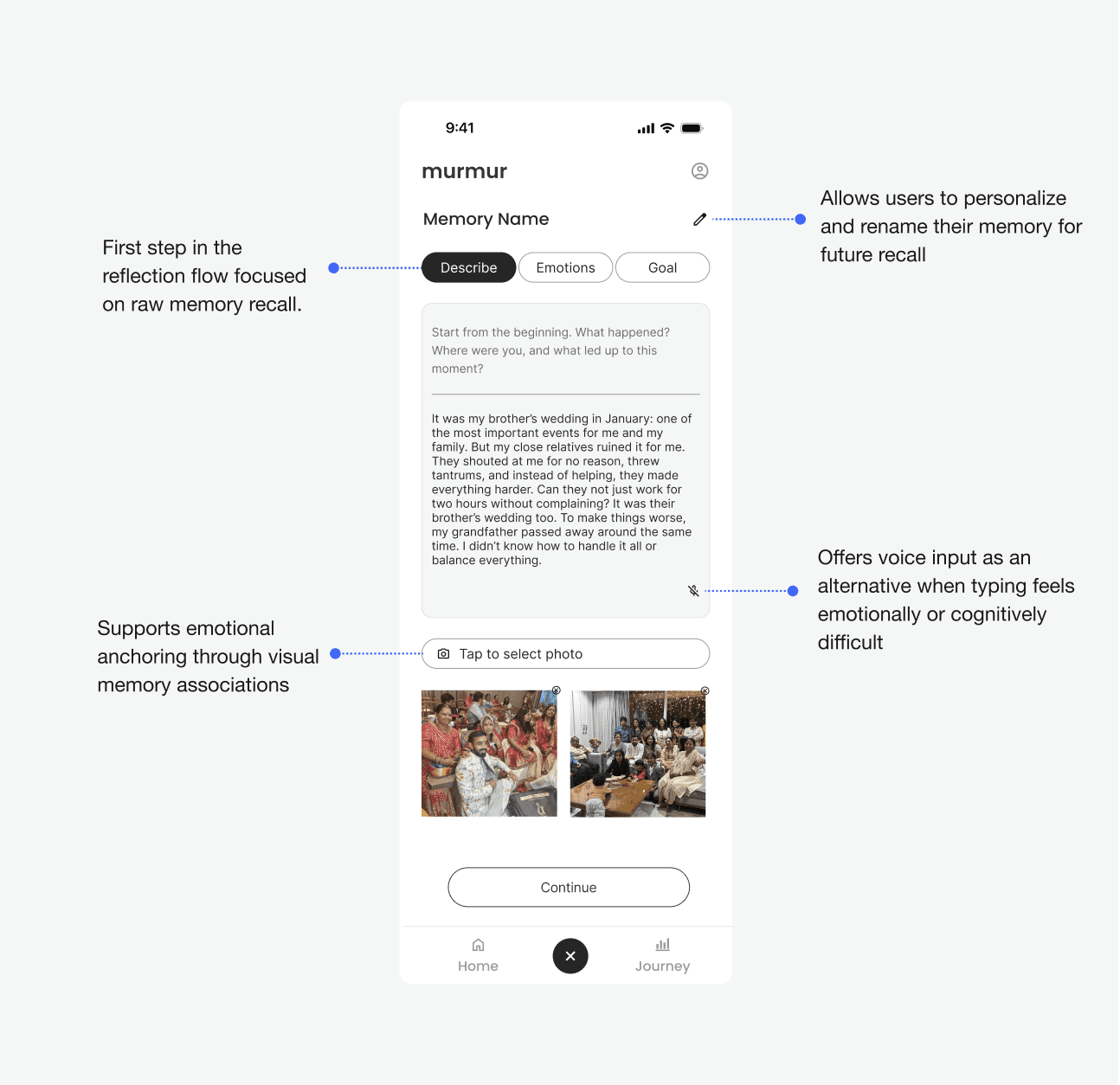
Step 01: Add Memory – Describe
Multimodal input: Users can write, record voice, or upload images accommodating different emotional states.
Open-ended venting: Survey insights showed users preferred open-ended input over structured templates.
Low friction start: Reduces the barrier to beginning a memory log, especially during overwhelming moments.
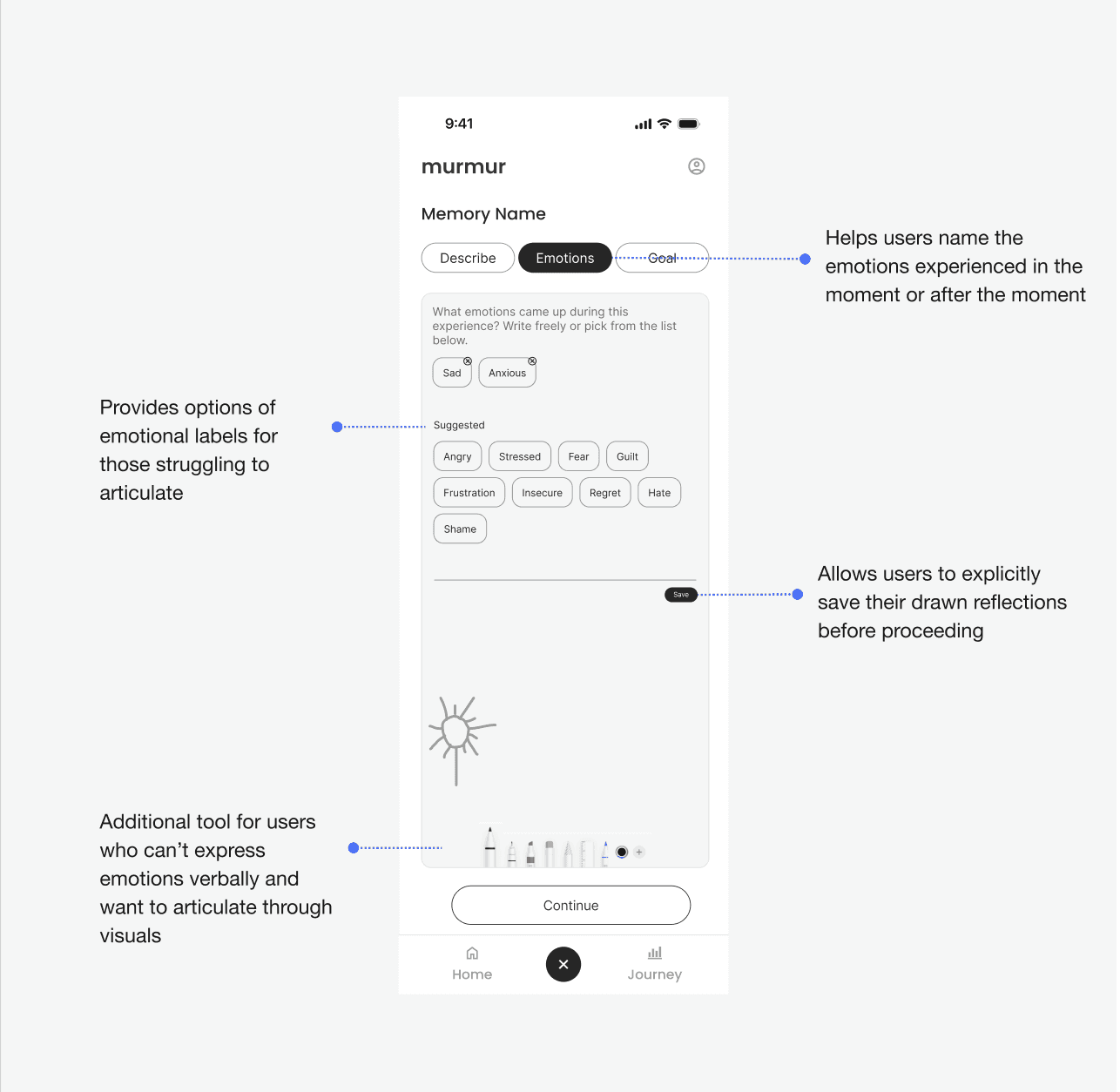
Step 02: Add Memory – Emotions
Explicit emotion labeling: Reflection deepens when emotions are explicitly acknowledged.
Structured + freeform: Balances emotion tags for users who struggle articulating with open text for expressive users.
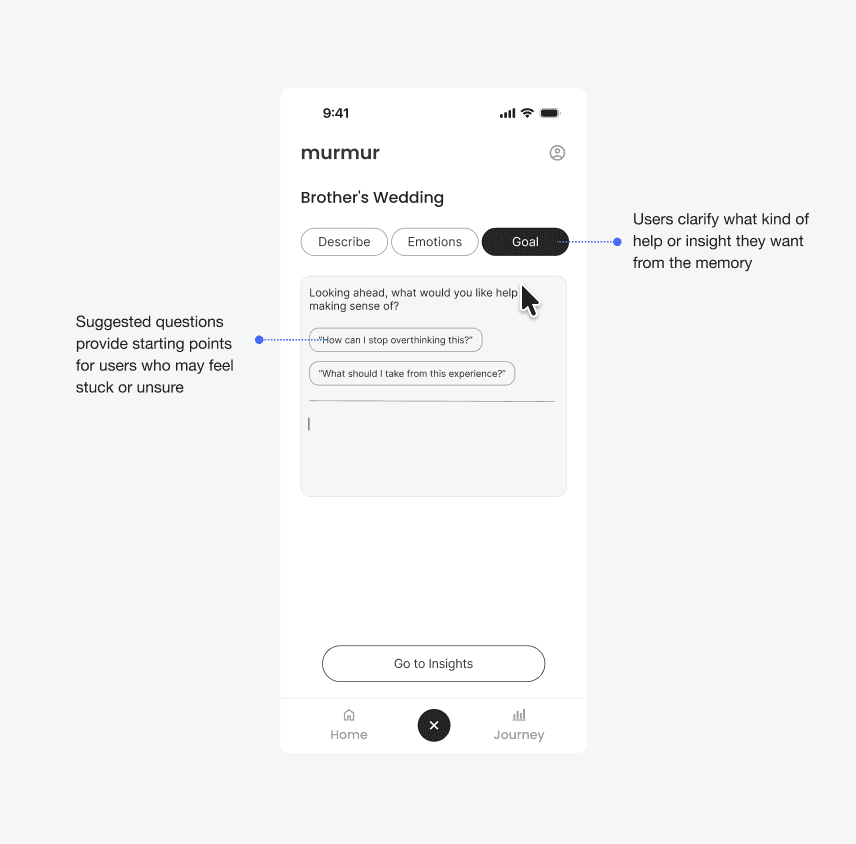
Step 03: Add Memory – Goal
Guided intentionality: Users clarify what they hope to gain, this informs the type of AI insights they receive later, personalizing the guidance.
Seeded prompts + freeform: Survey findings revealed users appreciated tools that guide but don't dictate their thinking. Pre-set options reduce blank-page anxiety.
Purpose before processing: Setting a goal before receiving insights creates a frame for reflection users know what they're working toward.
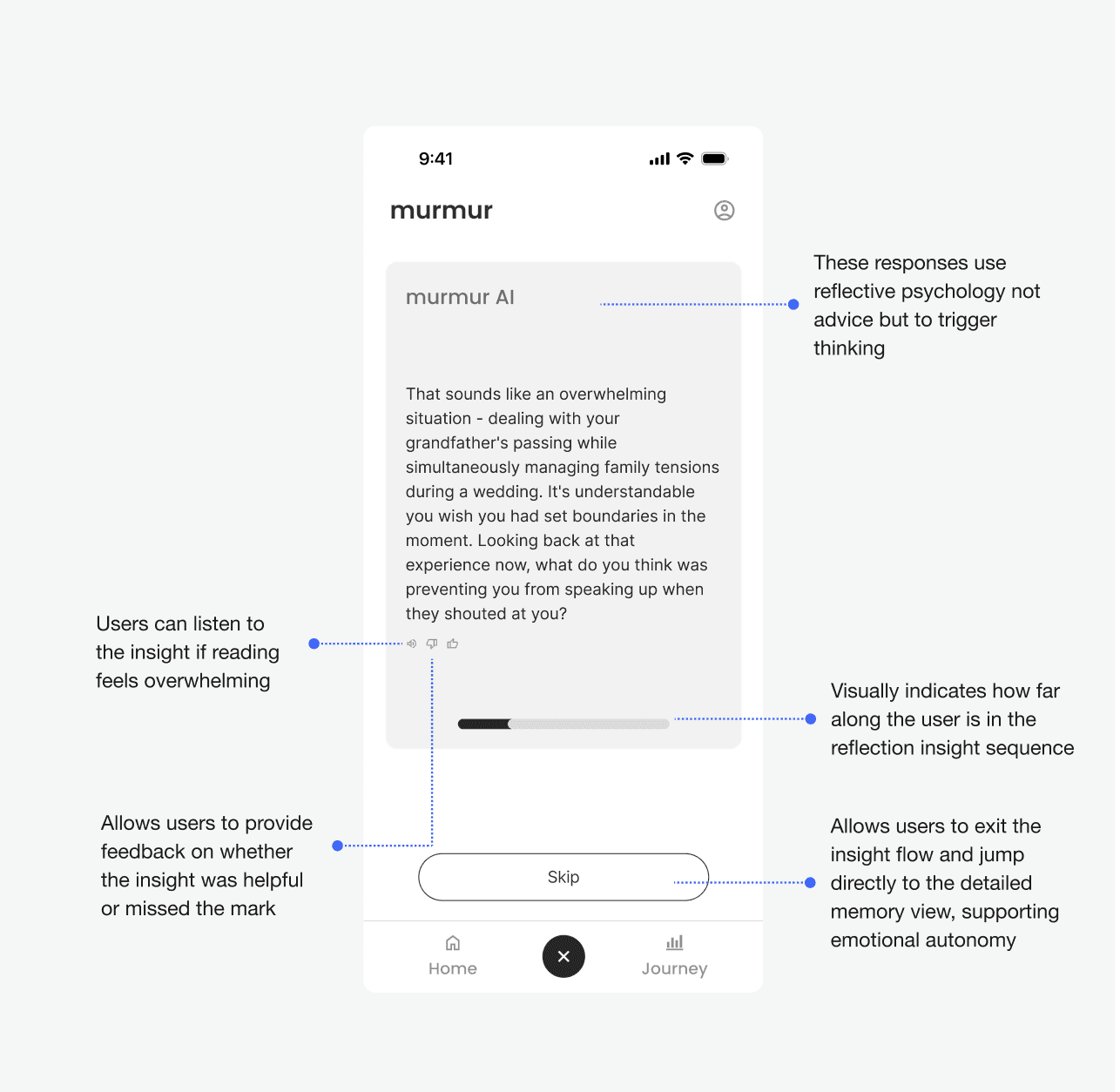
AI Insights – Reflection Cards
Reflective psychology, not advice: Uses prompts to trigger thinking rather than directing.
Reframing & Socratic questions: Offers new perspectives and gently prompts deeper self-inquiry.
Coping aids: Suggests grounding tools and emotion-labeling techniques.
Forward thinking: Encourages clarity and next steps.
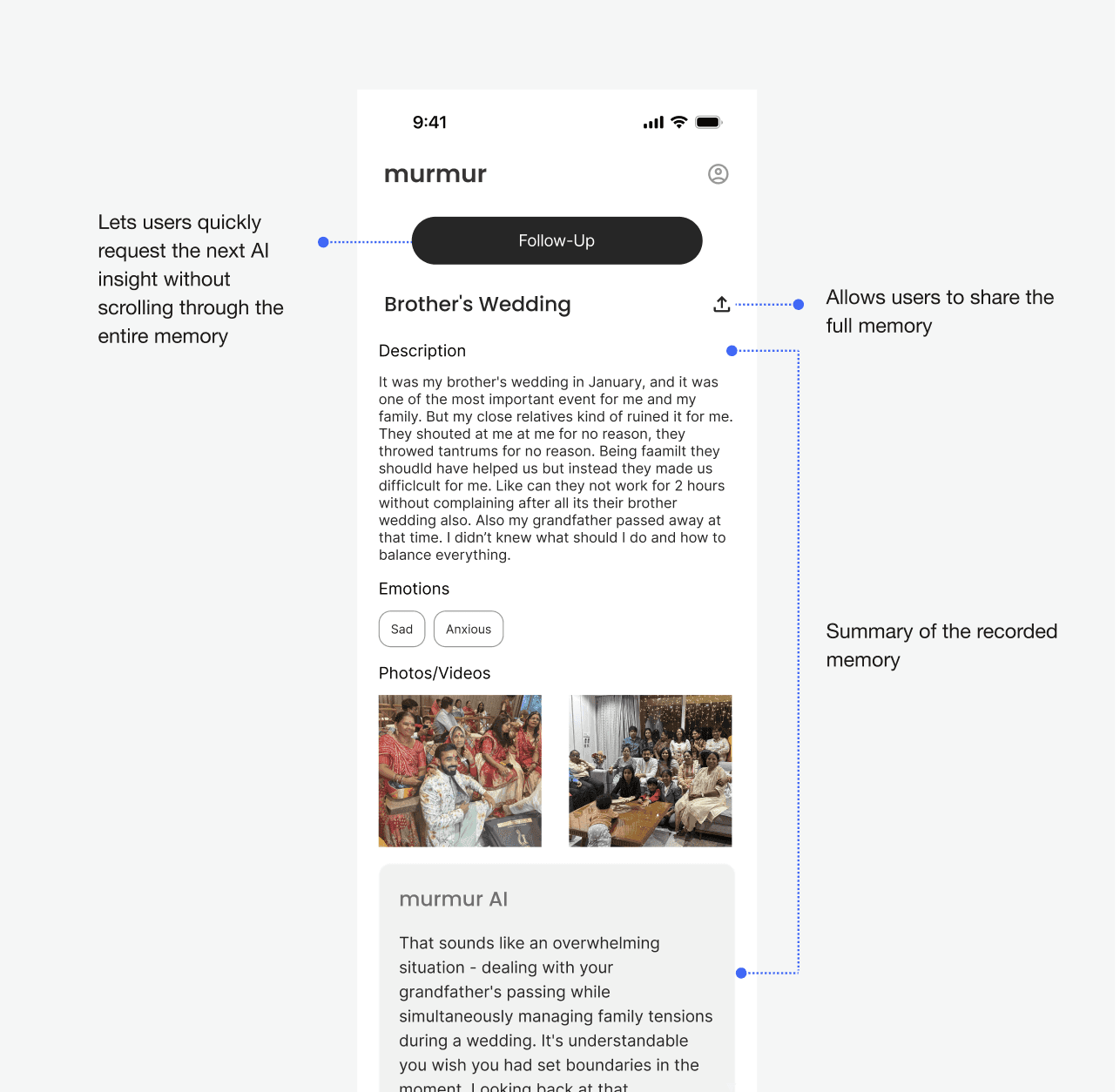
Memory Detail Page
Full reflection aggregated: This page centralizes the entire journey - user's entry, emotions, goal, AI insight, and follow-ups in one place.
Longitudinal tracking. Users can revisit past entries, track emotional growth, and see how their reflections evolve over time.
Continue or close: Users decide whether to keep reflecting or bring closure respecting the non-linear nature of emotional processing.
05
RESULTS
Test Summary Results
2 sessions with low and high fidelity prototypes. Tested with 4 peers and 2 expert users (6 total).
What worked well
1
Users appreciated emotional pacing and gentle tone
2
One-insight-per-day felt manageable and helpful
3
Emotion tagging and AI prompts were described as "supportive" and "reassuring"
Areas for Improvement
1
Users wanted an easier way to revisit follow-ups and past inputs
2
Doodling input was appreciated but functionality wasn't always intuitive
2
Initial separation of describe and insight created confusion about flow progression