Telos: Designing the Bridge to Self-Discovery
Category:
Mobile Design
Client:
World on Purpose
Redesigned onboarding for an AI-guided self-discovery platform, connecting users to their virtues, journeys, and reflective rituals
My Role
UX Designer
Duration
3 Months From Jan'26 to Mar'26
Methods
Competitor Analysis, Wireframing, Rapid Prototyping, Design Systems, High-Fidelity Prototyping, Usability Testing
01
OVERVIEW
About Telos
An AI-guided platform for self-discovery: helping people explore their values, set meaningful goals, and build reflective rituals. Unlike habit trackers or journaling apps, Telos positioned AI as a supportive layer: weekly summaries, reflection synthesis, gentle suggestions. Not a chat-first interface.
The Product Model
Profile as Compass
Not a static account page. The profile represents the user's virtues, personal direction, goals, habits, and values — a living sense of where they're trying to go.
Journey as Discovery
Where users move through structured exercises and reflections across different parts of life. Personalized by their virtues and goals.
Coach as Re-centering
The AI coach helps users reflect, summarize, and re-center, weekly summaries, reflection synthesis, gentle suggestions. Not a chat-first interface.
02
PROBLEM
Why Onboarding Needed Redesign
of the user pain points we identified traced back to onboarding and not the product itself. The product had depth. The entry point didn't.
Without the right onboarding, users were lost
What Users Felt
1
Unsure what the product actually does
2
Confused about the relationship between Profile, Journey, and Coach
3
Uncertain why they were being asked reflective questions
4
Overwhelmed by too much open-ended input early on
5
Skeptical if AI felt too central or vague
What Onboarding Needed To Do
1
Create clarity about the product's purpose
2
Build motivation to engage with reflection
3
Establish trust in the system and AI's role
4
Give structure without removing depth
03
Research
What exists and what's missing
I analyzed the closest competitors to understand where existing tools fell short. The pattern was clear: most tools position AI as the main event, overwhelming users with chat interfaces rather than guiding structured self-discovery.
Reflectr
AI journaling with prompts. Open-ended writing focused.
No structure beyond prompts
Headspace / Calm
Guided meditation and wellness. Session-based model.
No personal value system
AI Chat Apps
GPT-based conversation. Freeform dialogue.
No progressive self-discovery
The gap was clear: no tool combined structured self-discovery, personal values, and AI support into a connected system. Telos had the vision — it just needed the right entry point.
04
APPROACH
What I Redesigned
I redesigned onboarding so it became the bridge into the whole product, not a separate flow. Instead of simply collecting information, onboarding helped users understand how their virtues shape the experience, how journeys are personalized, how rituals support growth, and how the AI coach fits in.
1
Reframed onboarding as a connected system
Bridge into Profile, Journey, and Coach
2
Designed virtues and identity setup
Users define or unlock their personal compass
3
Built flexible ritual setup
Opt-in during onboarding or manage later
4
Reduced friction in reflective prompts
Mix of structured + open-ended inputs
Making It Lower-Friction
Structured Over Open-Ended
Moved toward more multiple-choice and structured questions instead of fully open-ended ones. Grouped related prompts thoughtfully. Broke things into manageable steps rather than long reflective forms.
Answers That Carry Forward
Onboarding answers power personalized journeys, reflective prompts, habits, rituals, and future AI summaries. Nothing disappears into a void — every input shapes what comes next.
How might we redesign onboarding to act as the bridge into the full Telos experience making a complex reflective product feel clear, personal, and worth committing to?
05
SOLUTION
Designing the Flow
MOVE 01
Start with choice
Users can either select their virtues directly or take a short quiz to discover them. This supports both power users who know their values and users who need guided help.

9:41
The first step is to understand the core virtues that guide you.
You can take a quiz or select them manually.
Take a 2-minute quiz
Select my virtues
Continue

MOVE 02
Set the rhythm
Before building their profile, users choose a daily or weekly check-in cadence and the types of prompts they want. This makes engagement feel intentional and adjustable.
9:41
Now, design your own ritual to recenter and live on purpose.
You can customize your ritual as you grow.
How often?
Daily
Weekly
Day
8:00PM
Sunday
Time
9:00AM
4:00PM
Virtues
Reconnect to your core virtues
Vision, Goals, and Habits
Unlock these sections in your profile.
Reflection
Add questions to reflect in your way
What are your intentions for next week?
Add a question...
Continue
MOVE 03
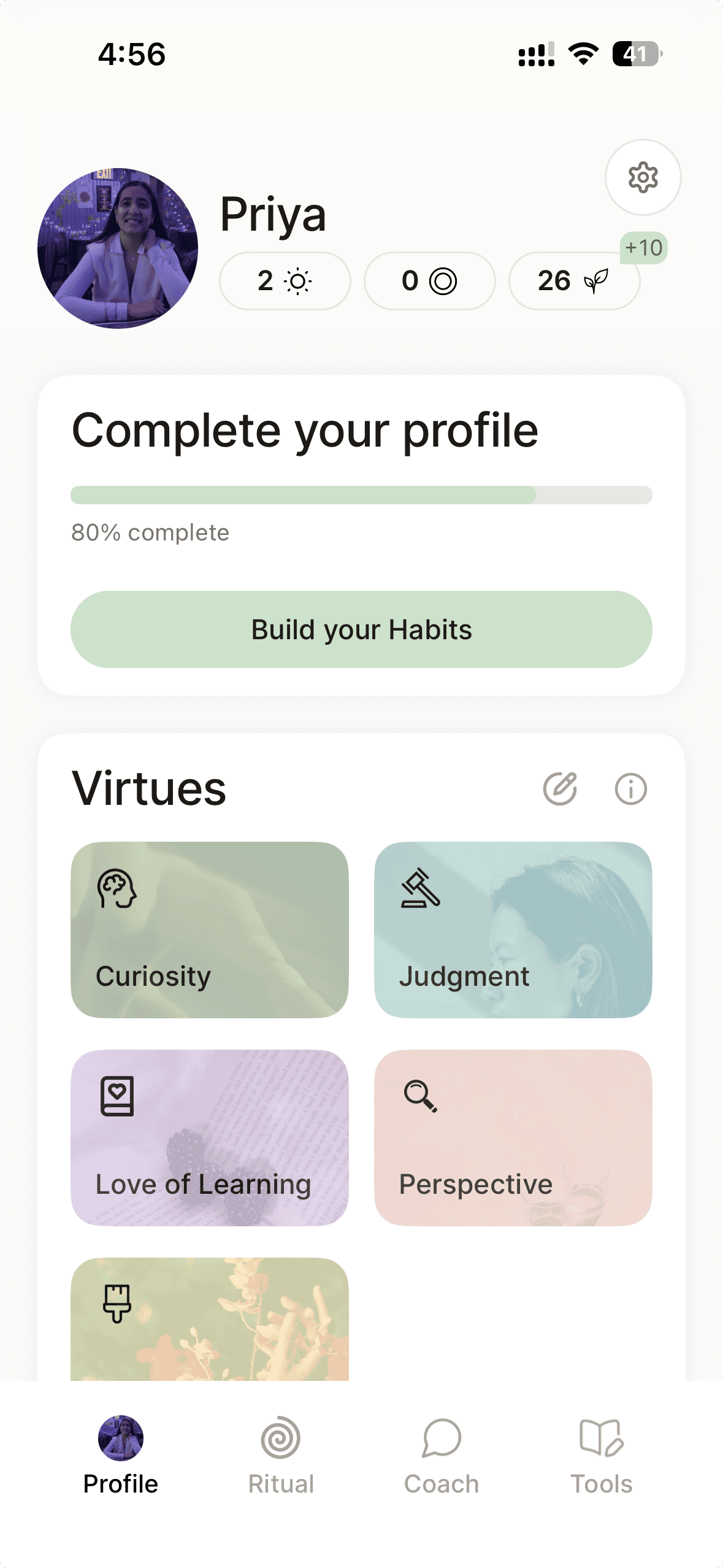
Build, don’t inherit
The profile starts with virtues but stays intentionally open. Users gradually add visions, goals, habits, and reflections, giving them ownership over what the profile becomes.
MOVE 04
Let AI enter with context
After completing an exercise, users unlock a new part of their profile and can go deeper with the coach. The AI responds to what the user just created, rather than starting as a generic.

9:41
Vision
You unlocked a Vision to your profile. Update it as life evolves.
Return to Profile
Go Deeper with Coach
Share with a friend
MOVE 05
Make reflection repeatable
Daily or weekly rituals turn reflection into small, focused check-ins. The questions are lightweight so users can keep returning without feeling overwhelmed.
Today 11:11AM
Hey Samantha!
I’m Telos. You can think of me as a wise friend with a PhD in Positive Psychology. I’m always a message away and will be your guide to make the most of this app.
Let’s get started with creating your profile. The first step is choosing times you want me to check-in and remind you to reflect. Then, we can dive into a few powerful exercises!
How does that sound?
Sounds good
Awesome :)
So, what’s a convenient time I can check-in on you in the morning and evenings? We all have one minute per day to pause and it’ll be a gentle nudge to reflect.
Oh and a quick tip - try responding through voice notes!
1:11
9:41
Message...
Personal Ritual
Tap the values that feel
most important right now.
Skip

Creativity

Leadership

Kindness

Humor

Honesty
MOVE 06
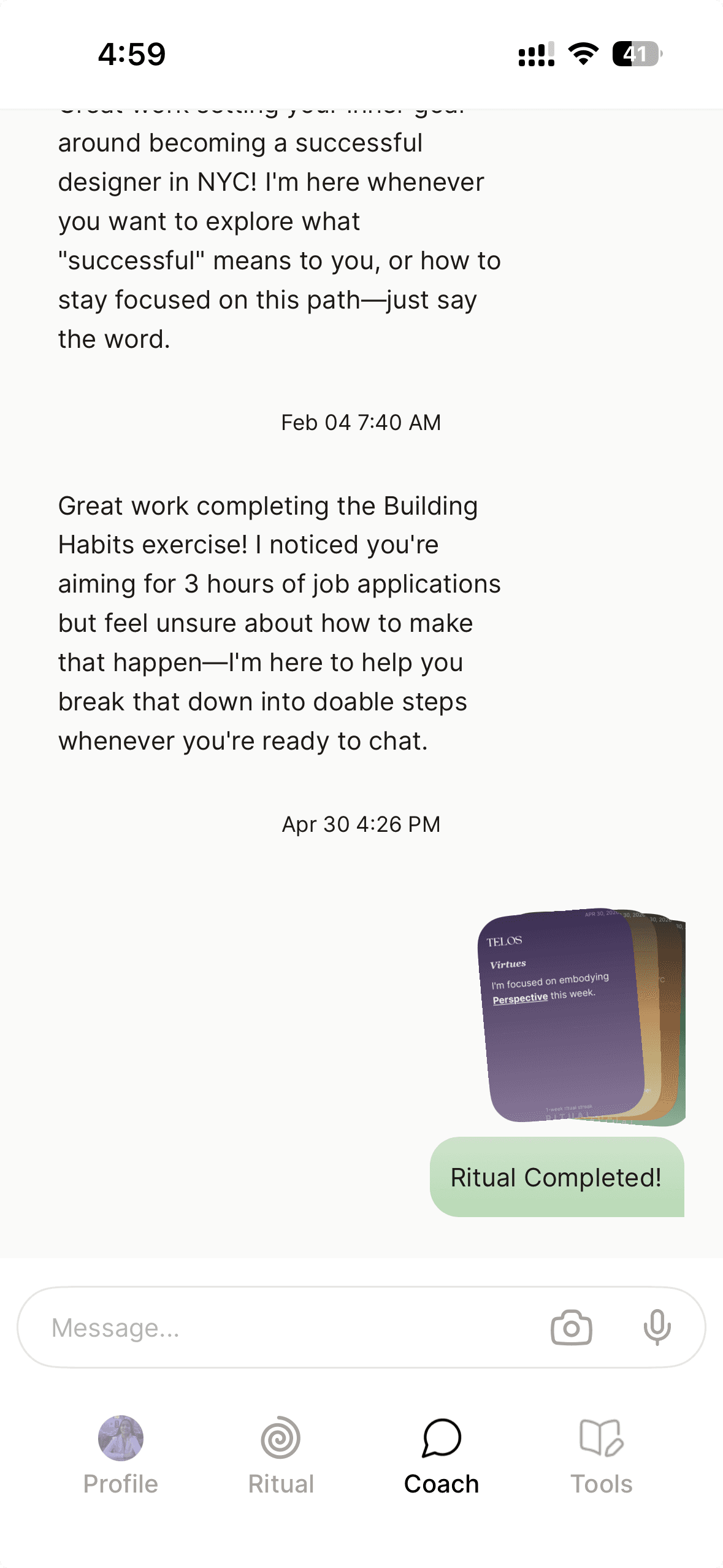
Coach with accountability
Completed rituals become cards users can revisit, discuss with the coach, or share with friends. This connects personal reflection with support and accountability.
06
REFLECTION
AI should support, not dominate
Instead of making users talk to AI all the time, we positioned it carefully: weekly summaries, reflection synthesis, gentle suggestions. This made the experience intentional and reduced over-reliance on AI.
Reflection should be guided, not overwhelming
Reducing too much free-form writing upfront. Creating structured progression. Making earlier answers stay visible. Reflection should feel guided rather than demanding.
Long-term engagement over daily pressure